
The AI Management Office – The Missing Piece for a True AI-Native Transformation
Why about 80% of employees give up after three weeks and why technical training alone is not enough.
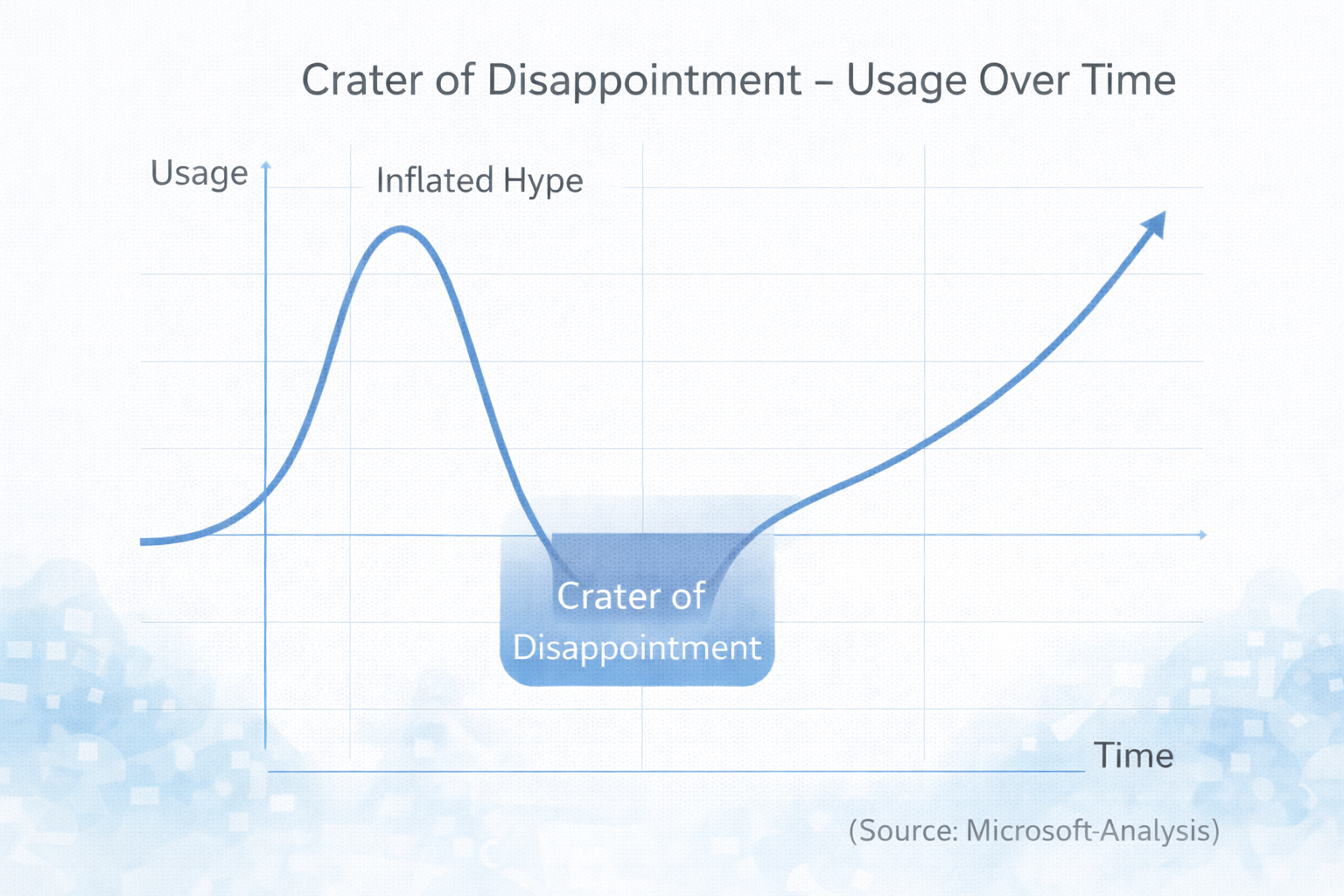
Many companies today face a puzzle: they introduce advanced AI tools like Copilot or ChatGPT, offer training, and still see no sustained usage. A recent analysis of 300,000 Microsoft users reveals a sobering pattern: after initial enthusiasm there is a massive drop after about three weeks (the “Crater of Disappointment”). The result? About 80% of licenses remain unused, while only roughly 20% of the workforce actively integrate the tools into their daily work.
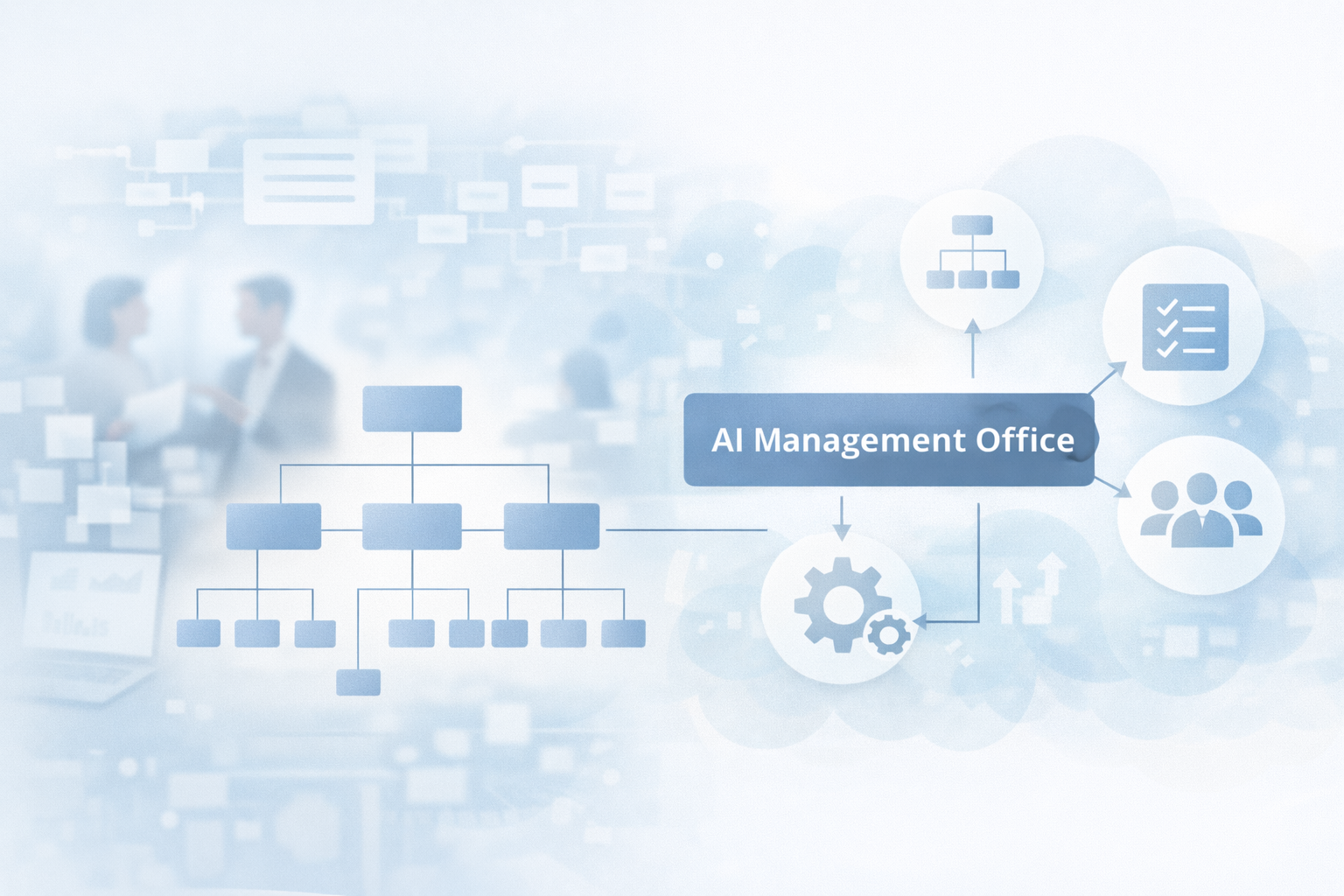
For a true AI-native transformation it is not enough to distribute licenses. Companies need an institutional response to this problem: an AI Management Office (AIMO). Based on the insights from the attached video we explain why the previous strategy fails and how an AIMO must close the “missing middle” of AI competence.
The problem: the gap between Prompting and coding
The reason employees give up lies in the wrong type of training. The current market focuses on two extremes:
- Level 101 (Basics): How do I write a Prompt? What can the tool do in general?
- Level 401 (Technical): API integrations, RAG architectures and Python scripts.
What is missing is Level 201: the ability to meaningfully integrate AI into existing workflows. The employees who stick with it (“Survivors”) have realized one thing: AI competence is not a technical skill, but a management skill. The best AI users are often not the best coders, but good managers who can delegate tasks, check results and steer processes.
Why an AI Management Office?
A classic IT department often treats AI like a deterministic software system (Input → Output). AI, however, behaves more like a new, talented but inexperienced employee. An AI Management Office (AIMO) therefore must take on the role of a strategic enabler that not only provides technical support, but builds organizational capabilities.
The six Level-201 capabilities
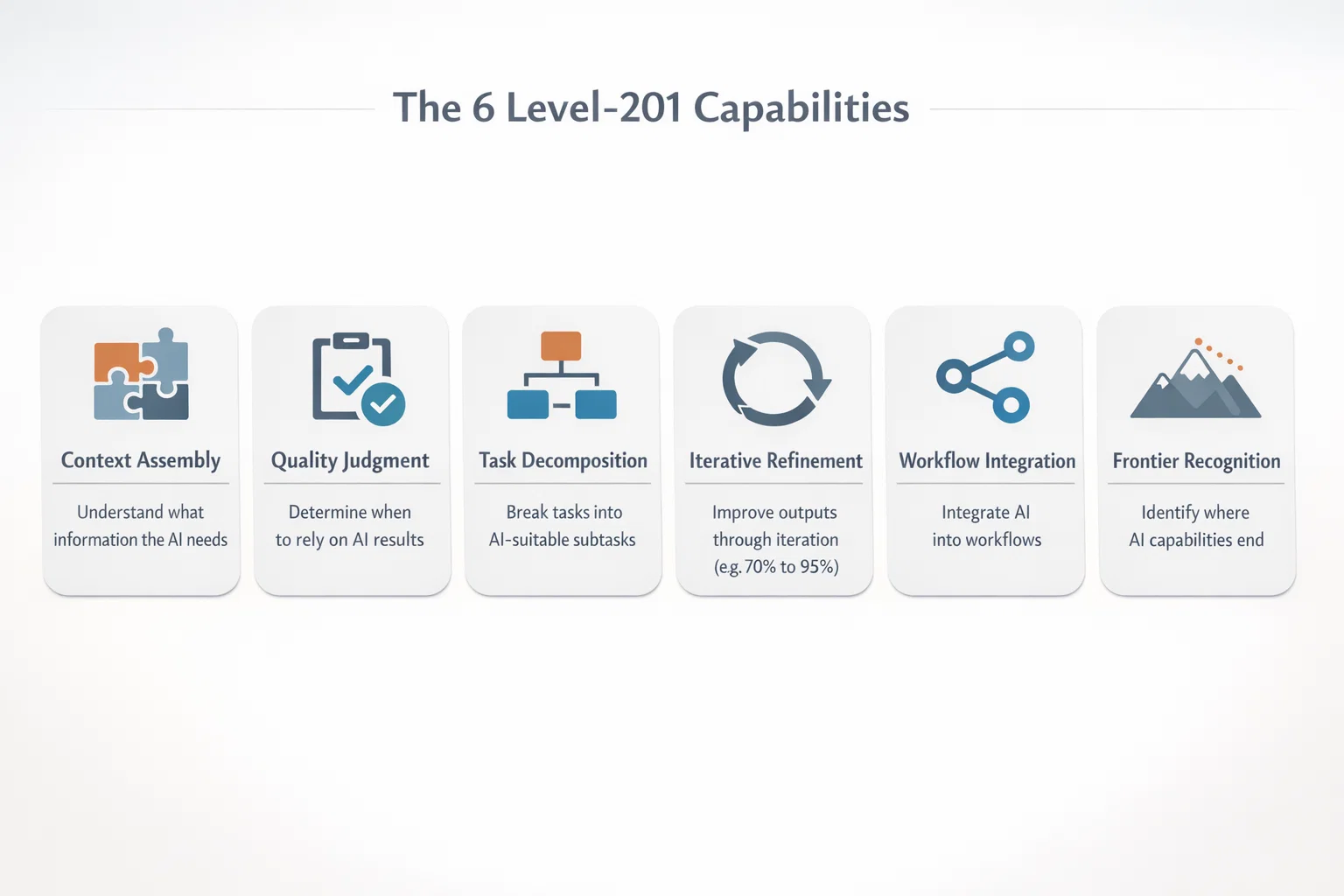
The AIMO has the task of teaching the following six crucial “Level-201” capabilities that are missing in standard trainings:
- Context Assembly (Kontext-Montage): Understanding which information the AI needs to deliver high-quality work, instead of blindly inserting documents.
- Quality Judgment (Qualitätsurteil): The ability to recognize when you can trust the AI and when you must (especially for critical tasks) perform in-depth checks.
- Task Decomposition (Aufgabenzerlegung): Breaking work into AI-friendly subtasks, similar to delegating work to an intern.
- Iterative Refinement (Iterative Verfeinerung): Not accepting the first output as the final result, but increasing quality from 70% to 95%.
- Workflow Integration: Not seeing AI as a separate “tool”, but fundamentally redesigning the work process (e.g., “This is how we now do RFPs”).
- Frontier Recognition (Grenzenerkennung): Knowing where the AI’s capabilities end to avoid performance cliffs.
From IT security to a “Permission Culture”
Another critical reason for a dedicated AI Management Office is overcoming fear. Many employees don’t use AI because they are unsure (“Am I allowed to do this?”). If the first association with AI is a “red stop sign” from IT security, adoption fails.
An AIMO must define clear Guardrails that not only state prohibitions but explicitly show what good work with AI looks like. It must create spaces where mistakes and “Failure Cases” (where AI failed) are openly shared so the whole company can learn where the technology’s limits lie.
Conclusion: Invest in judgment
The difference between mere AI activity and genuine AI fluency is not in the tools, but in investing in the “Judgment Layer” – the judgment of employees. Those who want to win back the 80% of employees who currently give up must shift training from pure technical skills to management competencies.
The following video dives deep into the analysis of the “Microsoft study” and explains in detail how companies can close this “Level-201” gap.